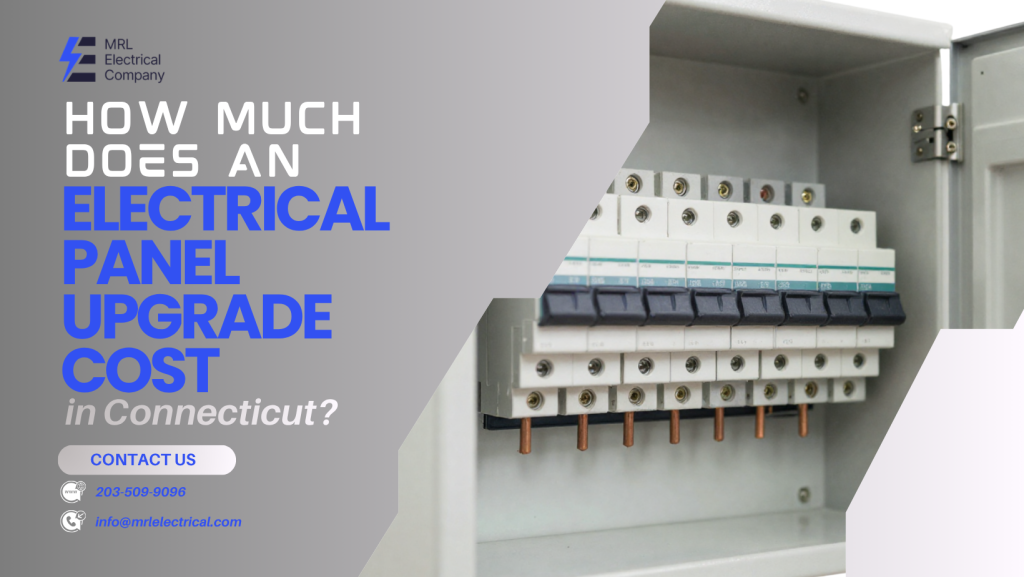
If you’re a Connecticut homeowner wondering what an electrical panel upgrade costs, here’s the short answer: most upgrades run $1,500–$4,500, with the final price depending on your home’s current setup, the amperage you need, and how much work is involved beyond the panel itself. Understanding the electrical panel upgrade cost in Connecticut upfront helps you budget accurately and avoid surprises once a licensed electrician takes a closer look at your home.
Panel upgrades aren’t one-size-fits-all. A straightforward swap in a home with modern wiring costs far less than a full service upgrade that involves your meter, utility coordination, and permit work. This guide breaks down what Connecticut homeowners typically pay, what drives the price up or down, and how to know if it’s time for an electrical panel upgrade — whether you’re dealing with a tripping breaker, planning for an EV charger, or just want peace of mind that your home’s electrical system is safe.
At a Glance: Electrical Panel Upgrade Costs in Connecticut
| Scenario | Typical Cost Range |
| Basic panel swap (same amperage, same location) | $1,200 – $2,500 |
| 100A to 200A upgrade | $1,800 – $4,000 |
| 200A panel replacement with new breakers | $2,000 – $4,500 |
| 400A or larger service | $4,500 – $8,000+ |
| Subpanel addition | $800 – $2,500 |
What’s usually included: removal of the old panel, installation of the new panel and breakers, labor, and basic permit filing.
What can increase the price: meter or service entrance replacement, utility coordination, older/unsafe panel brands (like Federal Pacific or Zinsco), wall repairs, and long wire runs. These factors are the main reason the electrical panel upgrade cost in Connecticut can vary so widely between homes, even within the same town.
What an Electrical Panel Upgrade Is
The term “panel upgrade” gets used loosely, but it usually means one of a few different jobs, and the specific type you need has a big impact on cost. Some homeowners just need a straightforward panel swap, while others need a full increase in electrical capacity to support their home’s growing power needs. Connecticut’s housing stock spans everything from postwar homes with outdated 100-amp service to newer construction already wired for modern demands, so the right upgrade really does depend on your specific home. Understanding these distinctions also helps when comparing quotes, since two electricians might be pricing entirely different scopes of work under the same general label. Below are the four most common types of panel-related upgrades homeowners in Connecticut typically ask about. Knowing which one applies to you is the first step toward getting an accurate estimate.
Panel replacement
Swapping out an old or failing panel for a new one at the same amperage. This is the simplest and generally least expensive option, especially if the new panel goes in the same spot as the old one.
Service upgrade
Increasing the amount of power coming into your home — for example, going from 100 amps to 200 amps. This often involves more than just the panel: the meter socket, service entrance cable, and sometimes the utility connection may need to be updated too.
Heavy-up (100A to 200A)
A specific type of service upgrade, and one of the most common requests in Connecticut homes built before the 1980s. Homes with 100-amp service often can’t support central air, EV charging, or modern appliance loads without this kind of upgrade.
Subpanel installation
Adding a secondary panel to extend capacity to a specific area — like a garage, basement, or addition — without replacing the main panel. This is often the most affordable option when the main panel still has room to support it, and it’s a service MRL Electrical regularly handles as part of subpanel installation projects across Connecticut.
Connecticut Cost Breakdown
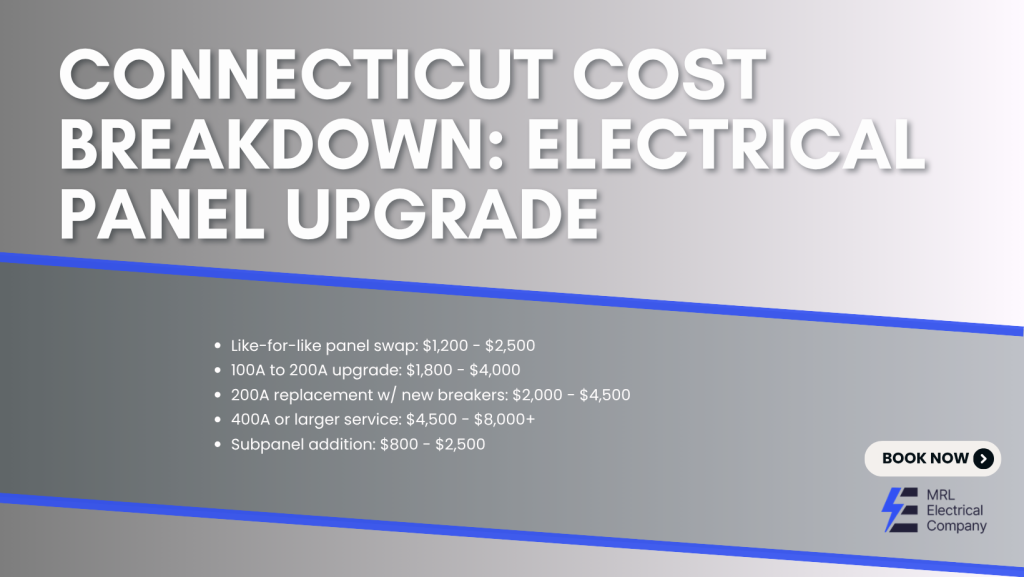
Now that you know the difference between a panel replacement, a service upgrade, and a subpanel, it helps to see how those distinctions actually play out in price. Connecticut homeowners often ask for a “panel upgrade” without realizing they’re really describing one of five fairly different scopes of work. Below, we’ve broken down typical costs for each common scenario, based on current Connecticut market pricing.
This breakdown gives you a realistic sense of the electrical panel upgrade cost in Connecticut for your specific situation, whether you need a simple swap or a full service increase. Keep in mind these are ranges, not fixed quotes — your home’s specific wiring, access, and code requirements will determine where you land within each range. Homes with newer wiring and easy panel access tend to fall toward the lower end, while older homes or more complex jobs tend to land higher. Use this breakdown as a starting point for understanding what your project might realistically cost.
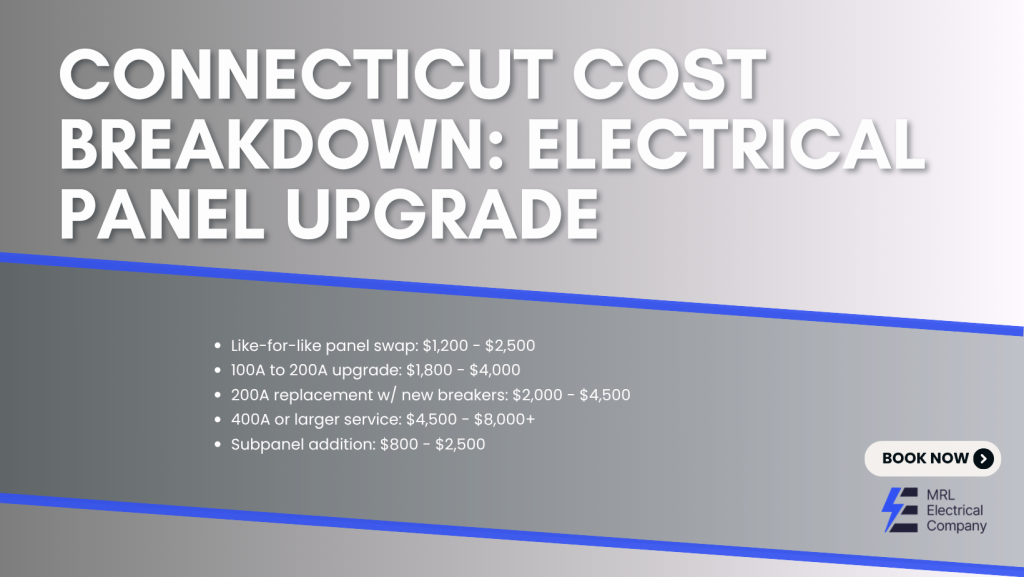
- Like-for-like panel swap: $1,200 – $2,500 – If your panel is simply old or failing but your home’s amperage is sufficient, this is the most straightforward and affordable option. It typically involves removing the old panel, installing a new one in the same location, and reconnecting existing circuits.
- 100A to 200A upgrade: $1,800 – $4,000 – This is the most common upgrade for older Connecticut homes. Cost depends on whether the meter socket and service entrance cable also need to be replaced, and how accessible your current setup is.
- 200A replacement with new breakers: $2,000 – $4,500 – For homes that already have 200-amp service but need a full panel and breaker replacement — often due to age, damage, or an unsafe panel brand — this scenario sits in the mid-to-upper range depending on the number of circuits involved.
- 400A or larger service: $4,500 – $8,000+ – Larger homes, homes with significant electrical loads (like EV charging plus a heat pump), or properties being prepped for major renovation sometimes require 400-amp service. If you’re planning ahead for EV charger installation or a heat pump conversion, it’s worth discussing your future power needs with your electrician before committing to a specific amperage.
- Subpanel addition: $800 – $2,500 – When you need more circuits in a specific area but your main panel doesn’t need replacing, a subpanel is usually the most cost-effective path. Price depends on distance from the main panel and the number of circuits added.
What Affects the Price
Two homes getting the “same” upgrade can end up with very different quotes, and that variation isn’t random — it comes down to a handful of specific factors your electrician will evaluate. Some of these factors are about your home’s existing infrastructure, like whether your meter or wiring already meets current code. Others are about physical access, since a panel that’s easy to reach costs less to work on than one buried behind finished walls. The amperage you’re targeting also plays a major role, since higher-capacity service generally requires more materials and sometimes additional utility involvement. Older homes in particular tend to carry a few of these cost drivers at once, which is why panel upgrades in older Connecticut housing stock often land toward the higher end of the range. Here’s a closer look at what typically moves the price up or down.
- Panel location and access – A panel that’s easy to reach — like one in a basement or garage with clear space around it — costs less to work on than one buried behind finished walls, in a tight closet, or in a hard-to-reach outdoor location.
- Meter and service entrance condition – If your meter socket or service entrance cable is outdated or doesn’t meet current code, it typically needs to be replaced alongside the panel. This adds both material and labor cost, and often requires utility coordination.
- Amperage target – Jumping from 100A to 200A costs more than a like-for-like swap, and 400A service costs more still. Higher amperage generally means larger equipment, more materials, and sometimes additional utility involvement.
- Age and code compliance – Older homes often have wiring or panel setups that no longer meet current electrical code. Bringing things up to code — like adding AFCI/GFCI protection — can add to the scope and cost of the job.
- Panel brand and safety issues – Homes with older panel brands known for safety issues, such as Federal Pacific or Zinsco, often need more than a simple swap, since these panels can indicate broader wiring concerns worth addressing at the same time. According to the National Fire Protection Association, electrical failures and malfunctions remain a leading cause of home structure fires, which is part of why older, recalled panel brands are treated as a priority safety issue rather than a cosmetic one.
- Wall repair and patching – If the electrician needs to open up drywall to access wiring or reroute cable, patching and repair costs can add to the total — though this is usually not extensive on standard upgrades.
For example: a straightforward panel swap in the same location typically costs less than a full service upgrade, and a home where the meter also needs replacement will cost more than one where it doesn’t.
Signs You May Need an Upgrade
Panel problems don’t always announce themselves clearly, which is part of why so many homeowners put off addressing them until something forces the issue. Some signs are subtle, like lights that dim slightly when a larger appliance kicks on, while others are more obvious red flags that shouldn’t be ignored. Age is also a factor worth considering on its own — even a panel that seems to be working fine may be outdated enough to pose a safety risk or limit what you can safely plug in. Life changes matter too: adding an EV charger, a heat pump, or central air can push an older panel past what it was ever designed to handle. The good news is that most of these signs are easy to spot once you know what to look for. Here are the most common indicators Connecticut homeowners notice before deciding to upgrade.
- Breakers trip frequently — especially when running multiple appliances at once, which can signal your panel is undersized for your home’s current load.
- Lights flicker or dim — particularly when larger appliances (like an AC unit or microwave) turn on, which can point to an overloaded or aging panel.
- Burn marks, discoloration, or a burning smell near the panel — this is a safety issue and warrants an inspection sooner rather than later.
- You have a Federal Pacific or Zinsco panel — these older panel brands are widely known for reliability and safety concerns and are commonly recommended for replacement.
- No room for new circuits — if your panel is full and you need to add one, an upgrade or subpanel may be necessary.
- You’re planning an EV charger, heat pump, central air, or a renovation — these additions often require more amperage than an older panel can safely provide.
If any of these sound familiar, it’s worth scheduling a panel safety inspection — even if you’re not ready to move forward with a full upgrade yet.
Permits and Inspection in Connecticut
Most electrical panel upgrades in Connecticut require a permit, and for good reason — panel work involves your home’s main electrical safety system, and inspection confirms the work meets current code. This process can feel like an extra hurdle, but it’s really there to protect you, not slow you down unnecessarily. A licensed electrician who regularly works in your area will already be familiar with local requirements, which makes the process far smoother than trying to navigate it yourself. Depending on the scope of your upgrade, you may also need coordination with your local utility provider, particularly if your amperage or meter setup is changing. None of this typically adds significant time to a well-planned project, but it’s worth understanding upfront so there are no surprises. Here’s a general breakdown of what the process usually looks like.
Permit filing
Your electrician typically handles the permit application with your local building department. Connecticut electrical permits are regulated at the state level by the Connecticut Department of Consumer Protection, which licenses electricians and oversees permitting standards statewide, even though individual towns issue and inspect the permits themselves. Requirements can vary slightly by town, so it’s worth confirming with your electrician what’s needed for your specific municipality.
Inspection
After the upgrade is complete, a local inspector reviews the work to confirm it meets code before the panel is signed off. This is a standard part of the process, not a sign that something’s wrong.
Utility coordination
If your upgrade involves changing your amperage or replacing the meter socket, your electrician will likely need to coordinate with your utility provider (such as Eversource or United Illuminating) to schedule a temporary power disconnect and reconnect. You can find outage scheduling and service coordination details directly through Eversource or United Illuminating, depending on which utility serves your area.
Timeline
Permit and inspection timelines vary by town, but a licensed, experienced electrician can typically walk you through what to expect for your specific project.
This process protects you as a homeowner — it confirms the work was done safely and can matter later for insurance, home sales, or resale value. Factoring permit and inspection requirements into your budget is part of understanding the true electrical panel upgrade cost in Connecticut, since these steps are rarely optional.
Cost-Saving Tips
A panel upgrade isn’t the place to shop for the cheapest possible price — safety and code compliance matter too much to cut corners on this kind of work. That said, cost-conscious homeowners do have legitimate ways to keep their project reasonably priced without sacrificing quality. A lot of it comes down to timing, planning, and asking the right questions upfront rather than reacting after a quote comes in higher than expected. Bundling related work, choosing the right moment in a renovation timeline, and understanding exactly what’s included in a quote can all make a meaningful difference. Here are a few practical ways to manage your costs.
- Get a site-specific quote – Pricing depends heavily on your home’s setup. A quote based on an actual look at your panel, meter, and wiring will be far more accurate than a phone estimate. : You can request a free, site-specific estimate from MRL Electrical to get an accurate picture of your project cost before committing to any work.
- Combine related electrical work – If you know you’ll eventually need other work done — like adding circuits, upgrading outlets, or wiring for a future addition — bundling it with your panel upgrade can save on labor costs compared to separate visits.
- Upgrade before a larger renovation – If you’re planning a remodel, addition, or major appliance install (like a heat pump or EV charger), upgrading your panel first can prevent costly rework later and may qualify for combined labor savings.
- Ask what’s included – Not all quotes include the same scope. Ask whether permit filing, inspection coordination, and cleanup are included in the price, so you’re comparing quotes accurately.
- Address panel issues early – Waiting until a panel fails completely often costs more than a planned upgrade, since emergency work can come with rush pricing and less flexibility on scheduling.
Why Hire a Licensed Electrician
Electrical panel work is one of the few home projects where cutting corners can put your safety — and your home’s safety — at risk, which is why licensing matters more here than on many other home improvement jobs. A panel isn’t just another component; it’s the central point where all of your home’s electrical power passes through, which means mistakes have outsized consequences. Beyond the safety element, there’s also a legal and financial dimension: unlicensed electrical work can create problems with inspections, insurance claims, and even future home sales. Here’s a closer look at what a licensed electrician brings to the table.
- Safety – Your panel is the central point where all of your home’s electrical power passes through. Mistakes here can cause fires, shock hazards, or damage to your home’s wiring and appliances.
- Code compliance – Connecticut has specific electrical codes that govern panel installations. These codes are based on the National Electrical Code, and licensed electricians are trained to apply the safety standards outlined by organizations like the NFPA to reduce fire and shock risks in every installation. A licensed electrician knows what’s required and ensures the work will pass inspection the first time.
- Permit and utility handling – Licensed electricians are familiar with local permitting processes and utility coordination, which can be confusing and time-consuming to navigate on your own.
- Warranty and accountability – Work done by a licensed professional typically comes with a workmanship warranty, giving you recourse if something isn’t right. DIY or unlicensed work generally doesn’t offer that protection — and may not be covered by homeowners insurance if something goes wrong.
- Long-term peace of mind – A properly installed panel, backed by a licensed electrician’s inspection sign-off, gives you confidence your home’s electrical system is safe — now and for future homebuyers if you sell.
Ready for a Panel Upgrade? Let’s Talk.
Deciding to upgrade your electrical panel is a big step, but figuring out your next move shouldn’t be complicated or stressful. Whether you’re dealing with frequent breaker trips, planning ahead for an EV charger, or simply want an expert opinion on whether your current panel is safe and up to code, getting clear answers starts with a conversation. Every home is different, which means the best way to understand your actual cost and scope of work is a site-specific evaluation rather than a generic phone estimate. If you’re ready to get a clear, accurate electrical panel upgrade cost in Connecticut for your home, our team is here to walk you through every step. MRL Electrical works with Connecticut homeowners at every stage of this process, from initial questions to permit filing to final inspection sign-off. Contact our team today to schedule your free estimate or ask any questions about your specific project.