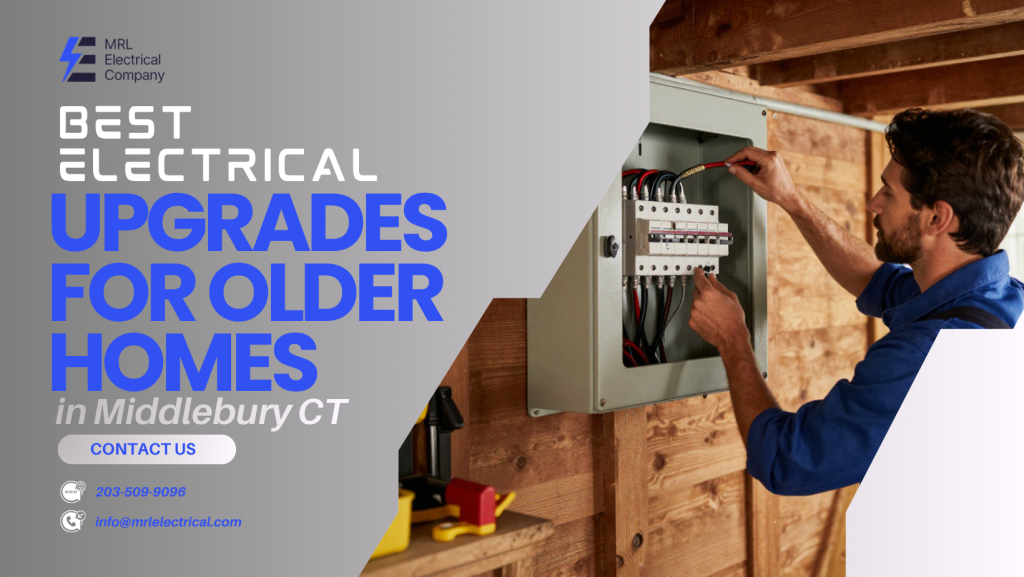
Walk through many of Middlebury’s older homes — the colonials near the town green, the farmhouses tucked along Breakneck Hill, the mid-century capes scattered through the neighborhoods off Route 64 — and you’ll find plenty of character. What you often won’t find is an electrical system built for how people actually live today. These homes were wired for a handful of lamps and a radio, not EV chargers, home offices, central air, and a house full of devices all drawing power at once. That’s why more homeowners are asking what the best electrical upgrades for older homes in Middlebury, CT actually look like — not just for safety today, but for the demands their homes will face for years to come.
That gap between old wiring and modern demand is where most electrical problems start. Homeowners aren’t imagining the risk, either — according to ESFI’s data on home electrical fires, electrical distribution systems remain one of the leading causes of residential fires in the U.S. each year. The good news is that homeowners don’t need to rewire everything at once to make real improvements. The best electrical upgrades for older homes in Middlebury, CT focus on the changes that matter most: improving safety, restoring reliable capacity, and preparing the home for the demands it’ll face in the years ahead — all without tearing the house apart to get there.
Why Older Homes Need Electrical Upgrades
Most electrical problems in older homes don’t show up as one big failure — they show up as small, easy-to-ignore signals that build over time. Recognizing these warning signs early can prevent a minor inconvenience from turning into a safety hazard.
Homeowners in Middlebury should pay attention if they notice:
- Frequent breaker trips — a sign the circuit is regularly overloaded, often because too many modern devices are drawing power from wiring designed for a much lighter load.
- Flickering or dimming lights, especially when an appliance turns on, which can point to loose connections, an overloaded circuit, or aging wiring.
- Two-prong outlets that lack a ground wire, common in homes built before the 1960s and unable to safely support many modern appliances and electronics.
- Outdated fuse boxes instead of a circuit breaker panel, which are harder to service, slower to reset, and often can’t support today’s electrical load.
- Buzzing, warm, or discolored outlets and switch plates, which can indicate loose wiring, overheating, or damaged components — all potential fire risks.
- Limited capacity for modern devices, such as needing extension cords or power strips just to run everyday appliances.
- Suspected knob-and-tube or aluminum wiring, both common in older Connecticut homes and considered outdated by today’s safety standards.
Any one of these signs on its own might seem minor. Together, or over time, they usually point to an electrical system that’s overdue for an upgrade. Understanding the best electrical upgrades for older homes in Middlebury, CT can help homeowners tell the difference between a quick fix and a sign that something bigger needs attention.
Best Electrical Upgrades for Older Homes in Middlebury, CT
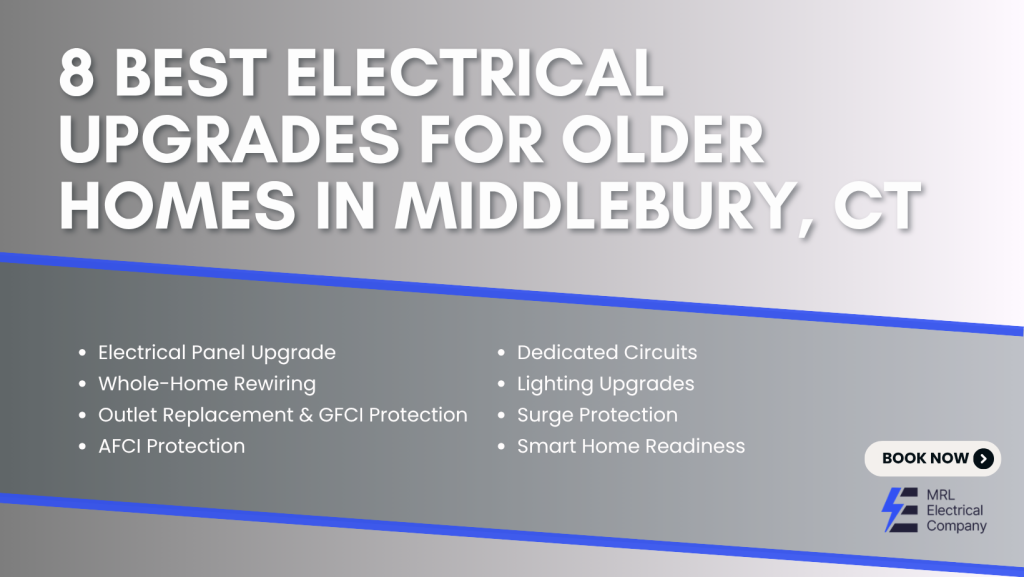
This is the core of the guide — the specific upgrades that make the biggest difference in an older home’s safety, reliability, and capacity. I’ll go through them one at a time, starting with the upgrade that most other improvements depend on.
Electrical Panel Upgrade
The electrical panel controls how much power a home can safely use at once. In many older Middlebury homes, the panel is undersized for modern life — still rated for the load of a house from decades ago, before central air, electric ranges, home offices, and multiple large appliances became standard.
A panel upgrade replaces this outdated equipment with a modern breaker panel sized for current and future needs. For homeowners ready to take that step, MRL Electrical’s electrical panel upgrade services are built specifically around the needs of older New Haven County homes. This matters for a few reasons:
- Safety. Overloaded or obsolete panels are a common source of overheating and electrical fires.
- Reliability. A properly sized panel reduces nuisance breaker trips and supports the home’s full electrical load without strain.
- Future capacity. A modern panel makes it far easier to add high-demand additions later, such as an EV charger, a backup generator, or a home addition, without another major electrical project. If backup power is part of that plan, it’s worth pairing a panel upgrade with MRL Electrical’s home generator installation services so both projects are sized correctly from the start.
For most older homes, the panel is the upgrade that everything else builds on. Undersized wiring, insufficient outlets, and inconsistent power are often symptoms of a panel that simply can’t keep up — which is why it’s usually the first thing a licensed electrician will evaluate.
Whole-Home Rewiring
Some older homes need more than a panel upgrade — they need the wiring itself replaced. Whole-home rewiring is the most comprehensive electrical upgrade available, and it’s typically recommended when a home has:
- Knob-and-tube wiring, an early wiring method (common in homes built before the 1940s) that runs individual wires through ceramic knobs and tubes rather than the sheathed cable used today. It lacks a ground wire, has no protective sheathing, and often can’t safely handle modern electrical loads.
- Aluminum wiring, which was used in some homes in the 1960s and 70s and is prone to loose connections and overheating at outlets and switches over time.
- Brittle or deteriorated insulation on existing wires, often the result of decades of heat exposure, which increases the risk of exposed conductors and electrical fires.
- Chronic circuit issues — frequent breaker trips, flickering lights, or dead outlets — that persist even after smaller fixes, suggesting the problem is in the wiring itself rather than an isolated component.
Rewiring is a bigger project than most other upgrades on this list, since it typically involves running new wiring throughout the home, in and behind existing walls. But for a home with genuinely outdated or damaged wiring, it’s the only upgrade that addresses the root problem rather than working around it. Everything downstream — outlets, switches, dedicated circuits, smart home features — depends on the integrity of the wiring behind the walls.
A licensed electrician can typically identify whether a home has knob-and-tube or aluminum wiring during an inspection, even without opening up walls, and can advise whether full rewiring or a more targeted approach makes sense.
Outlet Replacement and GFCI Protection
Many older homes still have their original outlets — and in some cases, those outlets are decades past their intended lifespan. Outlet replacement is one of the simpler upgrades on this list, but it addresses real safety and functionality issues:
- Two-prong outlets lack a ground wire, which means they can’t safely accommodate grounded appliances and electronics that most modern devices require.
- Worn or loose outlets lose their grip over time, which can cause plugs to fit loosely, arc, or overheat.
- Outdated outlet styles simply can’t keep up with the number of devices a modern household needs to plug in at once.
Alongside outlet replacement, GFCI protection is one of the most important safety upgrades for an older home. GFCI stands for ground-fault circuit interrupter — a device that monitors the electrical current in a circuit and instantly shuts off power if it detects a ground fault, such as current leaking through water or a person. Per the Consumer Product Safety Commission’s GFCI fact sheet, this simple device has played a major role in reducing home electrocutions over the past several decades. This makes GFCI outlets essential in areas where water and electricity are likely to be near each other:
- Kitchens
- Bathrooms
- Basements
- Garages
- Laundry areas
- Outdoor outlets
Many older homes were built before GFCI protection was required in these areas, which means they may still have standard outlets in locations where code now requires GFCI protection. Adding GFCI outlets in these rooms is a relatively affordable upgrade that significantly reduces the risk of electrical shock.
AFCI Protection
AFCI stands for arc-fault circuit interrupter — a device that detects dangerous electrical arcing, a common precursor to electrical fires, and shuts off power before it can ignite nearby materials like wood framing or insulation. Unlike a standard breaker, which responds to overloads and short circuits, an AFCI is specifically designed to catch the kind of intermittent, low-level arcing that often happens inside damaged or aging wiring — the exact condition many older homes are prone to. ESFI estimates that AFCI protection can prevent more than half of the electrical fires that occur in U.S. homes each year, making it one of the highest-impact upgrades on this list relative to its cost.
AFCI protection is especially valuable in the living spaces where people spend the most time and where fire risk has the greatest impact:
- Bedrooms
- Living rooms
- Family rooms
- Dens and home offices
For older homes, AFCI protection is often installed alongside a panel upgrade or rewiring project, since it requires either an AFCI breaker at the panel or an AFCI outlet on the circuit. It’s one of the upgrades that doesn’t change how a home looks or feels day to day, but meaningfully reduces fire risk in the rooms where a family spends the most time.
Dedicated Circuits
A dedicated circuit is a single circuit that powers only one appliance or piece of equipment, rather than sharing capacity with other outlets and devices in the home. Many older homes weren’t built with dedicated circuits in mind, since the appliances that require them today — microwaves, modern HVAC components, laundry equipment — simply didn’t exist or draw the same amount of power when the house was wired.
Without a dedicated circuit, a high-draw appliance shares its circuit with everything else on that line, which is a common cause of tripped breakers and inconsistent power. Adding dedicated circuits is especially useful for:
- Large kitchen appliances, such as microwaves, ranges, and refrigerators.
- Laundry equipment, particularly washers and electric dryers.
- HVAC components, including furnaces, air handlers, and mini-split systems.
- Home offices, where computers, monitors, and other equipment draw steady power throughout the day.
- EV charging, which requires a dedicated 240-volt circuit sized specifically for the charger. Since EV charging circuits, panel capacity, and wiring condition are closely connected, it’s worth having MRL Electrical evaluate all three together — you can schedule a consultation before committing to a charger installation.
Adding a dedicated circuit is a targeted upgrade — it solves a specific overload problem without requiring a full rewiring project, as long as the panel has the capacity to support it.
Lighting Upgrades
Lighting is one of the more visible upgrades on this list, but it’s still worth evaluating through a safety and functionality lens, not just an aesthetic one. Older homes often have limited or outdated lighting in exactly the areas where good visibility matters most.
Lighting upgrades are particularly valuable in:
- Stairways, where poor lighting increases the risk of falls.
- Basements, which in older homes often have minimal or single-source lighting.
- Exterior areas, including entryways, driveways, and walkways, where better lighting improves both safety and security.
Beyond safety, upgraded lighting — such as LED fixtures — also reduces energy use compared to older incandescent fixtures, which can add up over time in a home with dozens of light points. Lighting upgrades are often paired with switch replacement, since both involve working at the same fixture and are more efficient to handle together.
Surge Protection
A power surge is a brief spike in voltage that can damage or destroy electronics and appliances connected to a home’s electrical system. Surges can come from outside the home, such as lightning strikes or utility grid fluctuations, or from inside the home, caused by large appliances cycling on and off.
Older homes are often more vulnerable to surge damage for two reasons: they typically weren’t built with surge protection in mind, and they now often support far more sensitive electronics — computers, TVs, smart home devices, HVAC control boards — than the home’s original systems were ever exposed to. A single significant surge can damage multiple devices throughout the house at once.
Whole-home surge protection is installed at the electrical panel, which means it protects everything connected to the home’s wiring — not just the devices plugged into individual surge-protected power strips. For a home with modern electronics and appliances, this upgrade is a relatively low-cost way to prevent a much larger repair or replacement bill down the road.
Smart Home Readiness
Smart thermostats, video doorbells, smart lighting, and connected security systems have become common upgrades for homeowners looking to modernize an older house. But in a home with aging wiring or a limited panel, adding smart devices on top of an already-strained electrical system can create new problems instead of solving them.
Smart home readiness means making sure the underlying electrical system can actually support these devices before installing them:
- Sufficient panel capacity to handle the added, if modest, electrical draw of multiple smart devices running continuously.
- Stable, grounded wiring at the outlets and fixtures where smart devices will be installed, since many require a neutral wire that older wiring configurations don’t always provide.
- Reliable circuits, so smart devices aren’t affected by the same flickering or intermittent power issues common in older homes.
For homeowners in older Middlebury homes, the right order of operations matters: address the panel, wiring, and circuit issues first, then layer smart home upgrades on top of a system that can actually support them. Installing smart devices before fixing underlying electrical issues often means redoing work later — or living with a smart home system that doesn’t perform reliably.
Which Upgrades Should Come First
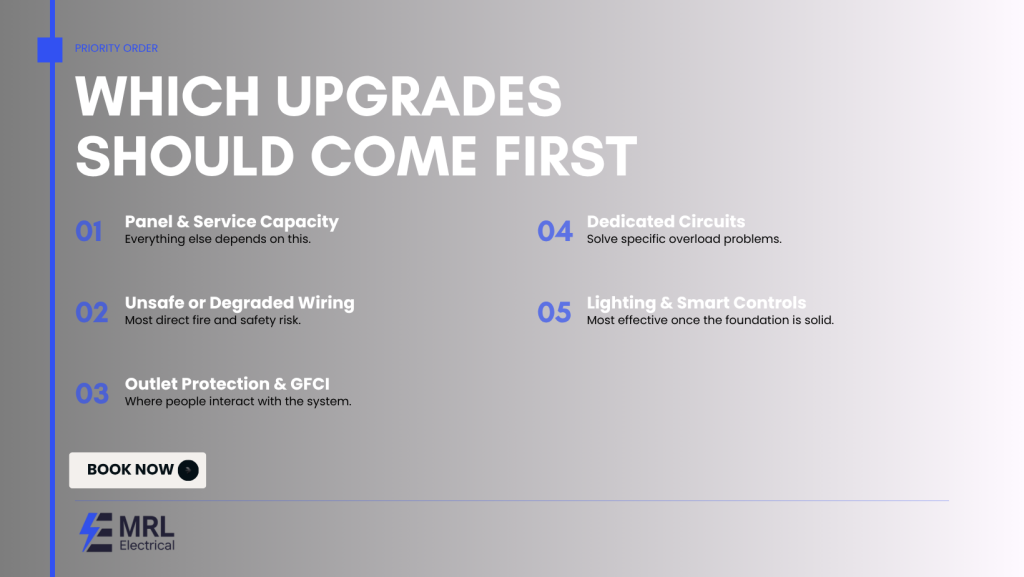
With nine possible upgrades, it’s natural to wonder where to start. Knowing the best electrical upgrades for older homes in Middlebury, CT is only half the equation — sequencing them the right way is what actually protects both your home and your budget. Not every older home needs every upgrade on this list, and tackling them in the right order helps homeowners avoid redoing work later. In general, the priority order below reflects how these upgrades build on each other — starting with the electrical system’s foundation and working outward toward convenience.
- Panel and service capacity. This comes first because nearly everything else depends on it. A panel that can’t support the home’s electrical load will limit or complicate every other upgrade.
- Unsafe or degraded wiring. Knob-and-tube wiring, aluminum wiring, or deteriorated insulation should be addressed early, since these represent the most direct fire and safety risks in an older home.
- Outlet protection and receptacle replacement. Once the panel and wiring are sound, updating outlets and adding GFCI protection addresses the points where people and appliances interact with the electrical system most directly.
- Dedicated circuits for overloaded rooms or appliances. With a stable foundation in place, dedicated circuits solve specific overload problems in kitchens, laundry rooms, home offices, and similar high-draw areas.
- Convenience upgrades like lighting and smart controls. These upgrades have the most visible, day-to-day impact, but they’re most effective — and least likely to need rework — once the electrical system underneath them is solid.
This order isn’t a strict rulebook for every home. This is exactly the kind of judgment call MRL Electrical’s experienced, licensed team helps homeowners work through during an initial evaluation. A house with a newer panel but old knob-and-tube wiring might reasonably prioritize rewiring first. The point is that safety and capacity upgrades generally come before convenience upgrades, since the latter depend on the former to work reliably.
Ready for a Safer, More Reliable Electrical System?
Older homes have a lot to offer — character, craftsmanship, and a sense of history that newer construction can’t replicate. But identifying the best electrical upgrades for older homes in Middlebury, CT is what makes sure that character isn’t hiding a safety risk behind the walls.
If your Middlebury home shows any of the warning signs covered in this guide — frequent breaker trips, outdated outlets, an aging panel, or wiring you’re not sure about — the next step is a professional evaluation. You can contact MRL Electrical directly to schedule that evaluation and get a clear, prioritized plan for your home. Whether you need one targeted fix or a full plan, MRL Electrical can help you map out the best electrical upgrades for older homes in Middlebury, CT — in the right order, at the right pace for your home.